 EN
EN Pyccкий
 May 28,2026
In the cup converting industry, one of the most frequent root causes of missed delivery deadlines is unplanned equipment downtime. Unlike a gradual decline in output, a sudden turret bearing seizure or a failed heating element can halt an entire production line for days — sometimes weeks — especially if critical spares are not on hand. The underlying issue is rarely a design flaw. More often, it’s a maintenance routine that slipped from “next week” to “someday.”
Maintenance in a cup forming environment is often viewed as an optional cost. In reality, it is the most reliable way to protect delivery schedules, control per-unit production cost, and extend the useful life of your investment. This article outlines a practical maintenance framework that operators and plant managers can adapt to their own equipment and shift patterns.
The Ripple Effect of Deferred Maintenance
When a paper cup machine experiences an unexpected failure, the consequences cascade far beyond the repair bill. Operators and packers stand idle, yet labor costs continue. Semi-finished material staged for the shift may need to be discarded if exposed to ambient humidity for too long. In many foodservice supply chains, a single late shipment can trigger penalty clauses or require expensive air freight to make up the shortfall. Over time, repeated delays erode buyer confidence — a far more expensive loss than any spare part.
Consider the bottom sealing station. A heating element that begins to drift out of its optimal temperature range rarely triggers an alarm. Instead, it produces cups that pass a quick visual check but exhibit a slightly elevated leak rate. Catching that drift early, through routine calibration, prevents the transition from a minor adjustment into a quality complaint or a product recall.
A Layered Maintenance Rhythm: Daily, Weekly, Monthly
You don’t need an engineering background to implement an effective maintenance plan. What matters most is consistency and a properly designed checklist.
Daily (Operator-Level)
-
Remove paper dust and coating residue from the feed track with a dry, lint-free cloth. Accumulated debris is a leading cause of mis-feeds.
-
Check the centralized lubrication reservoir level if the machine is equipped with one. Listen for any unusual sound during turret indexing — a change in pitch can indicate insufficient lubrication.
-
Inspect the curled rim on freshly produced cups. A consistently loose or irregular curl may point to a drop in cooling air pressure or worn curling rings.
-
Confirm that the counting sensor lens is clean and that the stacking chute is free of cup jams.
Weekly (Shift Supervisor or Technician)
-
Examine the bottom punching die for edge wear. A dull punch produces fuzzy cut edges that compromise bottom seal integrity.
-
For machines using ultrasonic sealing, verify the generator’s frequency tuning according to the manual. Even a slight drift can weaken seam strength.
-
Inspect pneumatic lines, especially those routed near hot surfaces. Hairline cracks or loose fittings alter clamping pressure at forming stations.
-
Run a 100-cup water leak test with dyed water. Record the result in a log; trending data can signal gradual degradation months before scrap rates rise.
Monthly (Maintenance Technician)
-
Replace or deep-clean all filters — hydraulic, pneumatic, and cooling fan intakes. Restricted airflow is a common cause of overheating.
-
Check turret plate parallelism with a dial indicator as specified in the equipment manual. Misalignment accelerates wear on the main drive gear.
-
Verify the accuracy of temperature controllers using a calibrated external thermocouple. Panel readings can drift, leading to under-sealing or over-sealing.
-
Compare the hour meter reading against the manufacturer’s recommended service intervals for the index gearbox and main drive components.
Adopting such a rhythm ensures that a well-supported cup forming system spends more time producing and less time awaiting repairs. The daily checks often take less than 15 minutes, yet they prevent days of reactive troubleshooting.
Four Persistent Maintenance Misconceptions
Myth 1: “New equipment doesn’t need attention.”
Every piece of converting machinery, even a freshly installed paper cup machine, requires a break-in service within the first 200 operating hours. During this period, fasteners can relax, belts bed in, and lubricant channels clear residual assembly debris. Skipping this initial service dramatically increases the risk of early-life failures.
Myth 2: “Any grease will do.”
Lubricants are not universally compatible. Mixing, for example, a lithium-based grease with a polyurea thickener can cause the mixture to harden, blocking grease pathways. Always use the exact lubricant specification found in the equipment manual. Incompatible grease substitution is a documented cause of gearbox damage in converting equipment.
Myth 3: “Sensors take care of themselves.”
Photo-eyes and proximity switches form the sensing network of the production line. Paper dust settling on a lens can cause intermittent, phantom stops that are difficult to diagnose. A regular wipe with isopropyl alcohol and a gap-distance check eliminate many unexplained faults.
Myth 4: “We only act when cups look bad.”
Visible defects — wrinkles, weak curls, uneven bottoms — are late-stage symptoms. The root cause often started days or weeks earlier as a bearing developing excess play or a heater element slowly degrading. Cup production equipment with built-in condition monitoring can detect these subtle changes, shifting maintenance from reactive to predictive and reducing scrap before it occurs.
Moving Toward Predictive Maintenance
Progressive operations are layering condition-based practices on top of calendar-based schedules. This might involve tracking the mean time between failures (MTBF) for critical wear parts, monitoring motor current draw for signs of increased mechanical load, or recording energy consumption per thousand cups produced. A rising trend in amperage often indicates a developing mechanical bind.
For machines without integrated sensors, a simple shift log provides a solid foundation. Record each fault with the cup counter reading, symptom, and confirmed root cause. Within a few months, patterns become clear: a bottom punch that consistently requires resharpening after a specific cup count, for example. That allows maintenance to be scheduled during planned downtime rather than discovered during a rush order.
A third paper cup machine equipped with remote diagnostic capabilities can further accelerate troubleshooting. When a supplier technician can securely access error logs and guide on-site staff, the mean time to repair often shrinks from days to hours. This type of connected support is becoming an expected feature among quality-focused equipment builders. Cup forming solutions with integrated diagnostics give operators and managers the data they need to make informed decisions about impending service needs.
Design Features That Make Maintenance Easier
When evaluating new equipment or planning a retrofit, certain design elements directly reduce the time and skill required for routine care:
-
Tool-less access to daily inspection points encourages checks to actually be done.
-
Captive fasteners that remain attached to panels when loosened reduce the risk of dropped or lost screws.
-
Clear fault messages on the HMI. A message like “Station 3 over-torque” is actionable; a generic error code is not.
-
Centralized lubrication with a low-level alarm eliminates guesswork and reduces the chance of a dry bearing.
-
Modular sub-assemblies, such as a cassette-style forming turret, can be exchanged quickly, dramatically reducing downtime for deep service.
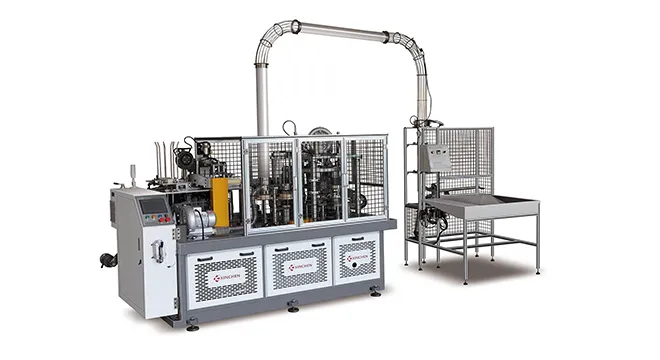
XINCHEN’s engineering approach prioritizes these practical, daily-use features. Whether an operation runs a single lane or multiple forming stations, the consistency in control logic and mechanical layout means a trained operator can quickly translate their knowledge from one unit to another. See how XINCHEN builds serviceability into every cup forming solution.
Maintenance as a Business Enabler
A documented, consistent maintenance program signals operational maturity to major buyers. When a foodservice chain audits a supplier, the presence of detailed service logs, calibration records, and a clean, well-maintained production floor provides tangible evidence of reliability. In many cases, this can be a differentiator that helps secure or retain high-volume contracts.
Start with the next shift. Walk the production floor with a notepad, listen to the equipment, and ask the operator which minor adjustment they’ve been compensating for. That small compensation is often masking a maintenance task that should already be scheduled. Addressing it now costs far less than the alternative.
Disclaimer: This article provides general guidance based on widely accepted industrial maintenance practices. Always follow the specific instructions in your equipment manufacturer’s manual. Maintenance intervals, lubricant specifications, and procedures vary by model, operating environment, and cup design. Consult a qualified service engineer for complex repairs.